LOS POSESIVOS
Adjetivos Posesivos en Singular
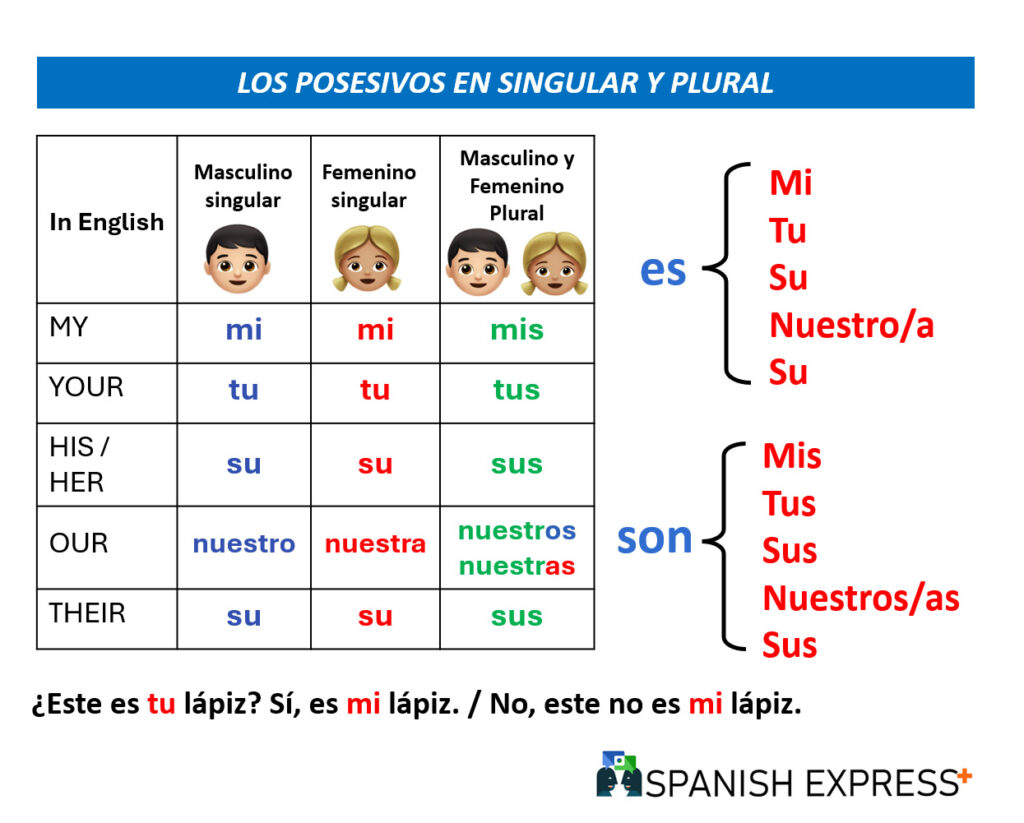
LOS POSESIVOS
Adjetivos Posesivos en Singular
| Poseedor | Cosa poseída | In English |
| yo | mi | my |
| tú | tu | your |
| él/ ella / usted | su | His/ her/ your |
| nosotros/as | Nuestro/a | our |
| ustedes | su | your |
| ellos / ellas | su | their |
Adjetivos Posesivos en Plural
| Poseedor | Cosas poseídas | In English |
| yo | mis | my |
| tú | tus | your |
| él/ ella / usted | sus | His/ her/ your |
| nosotros/as | Nuestros/as | our |
| ustedes | sus | your |
| ellos / ellas | sus | their |
Tabla de Pronombres Posesivos
Los posesivos son determinantes que indican posesión, que se tiene una cosa física o abstracta. Se usan para expresar a quién le pertenece un objeto, animal o persona, y están después del sustantivo, concuerdan con el género, el singular y plural.
| Persona (Dueño) | En Inglés | En Español (Singular) | En Español (Plural) |
| I (Yo) | Mine | el mío / la mía | los míos / las mías |
| You (Tú) | Yours | el tuyo / la tuya | los tuyos / las tuyas |
| He (Él) | His | el suyo / la suya (de él) | los suyos / las suyas |
| She (Ella) | Hers | el suyo / la suya (de ella) | los suyos / las suyas |
| It (Eso/Animal) | Its | el suyo / la suya (de ello) | los suyos / las suyas |
| We (Nosotros) | Ours | el nuestro / la nuestra | los nuestros / las nuestras |
| They (Ellos) | Theirs | el suyo / la suya (de ellos) | los suyos / las suyas |
Ejemplos:
* Juanito tiene un perro.
¿Ese perrito es tuyo Juanito?
+ Sí, ese perrito es mío.
– No, ese perrito no es mío, es de mi vecina.
* Nosotros tenemos una pelota.
¿Esa pelota es suya?
+ Sí, esa pelota es nuestra.
– No, esa pelota no es nuestra,
es de la escuela.
* Yo tengo unas medicinas.
¿Esas medicinas son tuyas?
+ Sí, esas medicinas son mías.
– No, esas medicinas no son mías.
* Ellos tienen hijos pequeños.
¿Esos hijos son suyos?
+ Sí, esos hijos son suyos. /son de ellos.
– No, esos hijos no son suyos. / No son de ellos.
- Published in Uncategorized
LOS PRONOMBRES – THE PRONOUNS
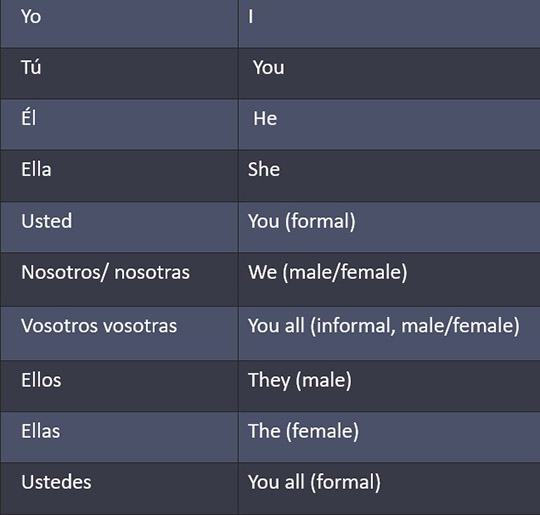
El pronombre sujeto/ The subject pronoun
Pronombres de Objeto Indirecto:
Los pronombres de objeto indirecto corresponden a la pregunta ‘¿A quién?’ y ayudan a identificar al destinatario de una acción.
Me (yo) – Te (tú) – Le (él/ella/ Ud.) – Nos (Nosotros) – Les (Ustedes, Ellos/as)
Ej.: singular Plural
Me à gusta la ciudad gustan las ciudades
Te à gusta el carro gustan los carros
Le à gusta la fiesta gustan las fiestas
Nos à gusta el helado gustan los helados
Les à gusta el parque gustan los parques
| A mí | me |
| A ti | te |
| A usted | le |
| A él, a ella | le |
| A nosotros | nos |
| A ustedes | les |
| A ellos/ a ellas | les |
Indirect Object (Objeto Indirecto)
The Indirect Object is the person or thing that receives the Direct Object or benefits from or is affected by the action. It answers the question “To whom?” or “For whom?”
Examples
- Yo le doy un regalo a mi madre.
I give my mother a gift.- Direct Object: un regalo (the gift)
- Indirect Object: a mi madre (to my mother)
- El profesor les explica la lección a los estudiantes.
The teacher explains the lesson to the students.- Direct Object: la lección (the lesson)
- Indirect Object: a los estudiantes (to the students)
- Carlos me envió un mensaje.
Carlos sent me a message.- Direct Object: un mensaje (a message)
- Indirect Object: me (to me)
Se Impersonal – Con Objeto Indirecto
In this type of construction, what would normally be the direct object in the sentence becomes the subject, and it agrees with the verb come up not with the indirect object.
| ¿A quien? | Se + O.I. Pron. |
| A mí A ti A usted A él/a ella A nosotros A vosotros A ustedes A ellos a ellas | …se me …se te …se le …se le …se nos …se os …se les …se les |
Pronombres de Objeto Directo:
The Direct Object receives the action of the verb directly. It answers the question “What?” or “Whom?” after the verb.
Recordemos que, en el Objeto Directo, es el objeto o ser sobre el que recae la acción del verbo de manera indirecta. Mientras que en el Objeto Indirecto es el objeto modificado o afectado por el verbo. While the Indirect Object is the person or thing that receives the Direct Object or benefits from or is affected by the action. It answers the question “To whom?” or “For whom?”
Ejemplo:
| Pron. Personal | Pronombres de O.D. |
| yo | Me |
| tú | Te |
| Él-Ud/ ella-Ud. | Lo – La |
| nosotros/as | Nos |
| vosotros | Os |
| Ellos-Uds/ ellas-Uds | Los – Las |
Yo le doy un regalo a mi madre.
I give my mother a gift.
- Direct Object: un regalo (the gift)
- Indirect Object: a mi madre (to my mother)
El profesor les explica la lección a los estudiantes.
The teacher explains the lesson to the students.
- Direct Object: la lección (the lesson)
- Indirect Object: a los estudiantes (to the students)
Carlos me envió un mensaje.
Carlos sent me a message.
- Direct Object: un mensaje (a message)
- Indirect Object: me (to me)
Easy Rule to Remember
- Direct Object = What? / Whom? → Receives the action directly.
- Indirect Object = To whom? / For whom? → Receives or benefits from the Direct Object.
Quick Example
Ana le dio un libro a Juan.
Ana gave Juan a book.
- Verb: dio (gave)
- Direct Object: un libro (What did Sara give?)
- Indirect Object: a Juan / le (To whom did Sara give the book?)
Reflexive Pronouns (Pronombres Reflexivos) in Spanish
What is a Reflexive Pronoun?
A reflexive pronoun is used when the subject performs the action and also receives the action. In other words, the person does the action to themselves.
Reflexive Pronouns
| Spanish | English |
| me | myself |
| te | yourself |
| se | himself / herself / yourself (formal) |
| nos | ourselves |
| se | themselves / yourselves |
Examples
- Yo me levanto temprano.
I get up early. - Tú te cepillas los dientes.
You brush your teeth. - Ella se lava las manos.
She washes her hands. - Nosotros nos acostamos tarde los fines de semana.
We go to bed late on weekends. - Ellos se visten rápidamente.
They get dressed quickly.
Easy Rule to Remember
A reflexive pronoun is used when the subject and the object are the same person.
Subject → does the action → to himself/herself/themselves.
Example:
María se peina.
María combs her hair.
- Subject: María
- Reflexive Pronoun: se
- Verb: peina
- Meaning: María performs the action on herself.
- Published in Uncategorized
EXCEPCIONES DE SUSTANTIVOS EN LOS ARTÍCULOS
¿Cómo podemos encontrar el artículo definido correcto en español para cada sustantivo? (How can we find the right defined article in Spanish for every noun?)
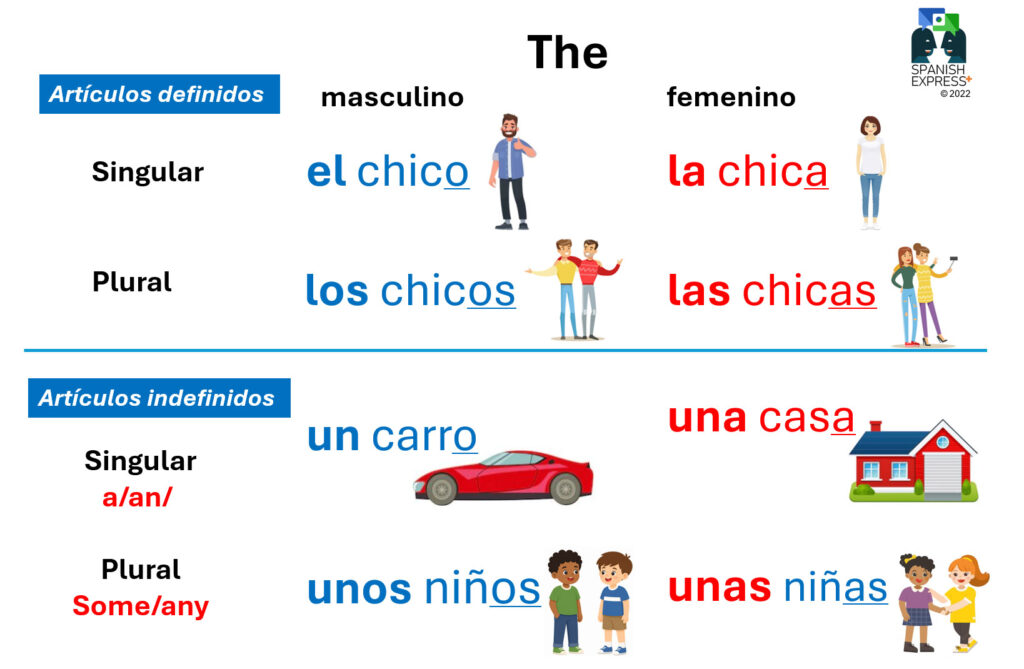
Reglas para el masculino/ Rules for masculine:
Casi todas las palabras que terminan en -o son masculinas.
Excepto: mano, radio, foto, etc.
La gran mayoría de las palabras que terminan en – r – l – n, o – s son masculinas.
Excepciones – “r” y “l”: mujer, flor, cárcel, miel, etc.
Excepciones – “n” y – “s”: imagen, razón, res, tos, etc.
– Si la palabra termina en – e, hay aproximadamente un 90% de posibilidades de que sea una palabra masculina.
Excepciones comunes: clase, calle, llave, mente, etc.
Reglas para el femenino/ Rules for feminine:
Casi todas las palabras que terminan en -a son femeninas.
Excepto: Mapa, planeta, problema, día, papá, etc.
Así mismo, todas las palabras que terminan en -ción, –ie y –umbre son femeninas.
Ej.: dirección, especie, cumbre, etc.
Con pocas excepciones, las palabras que terminan en
–dad, –tad y –tud también son femeninas.
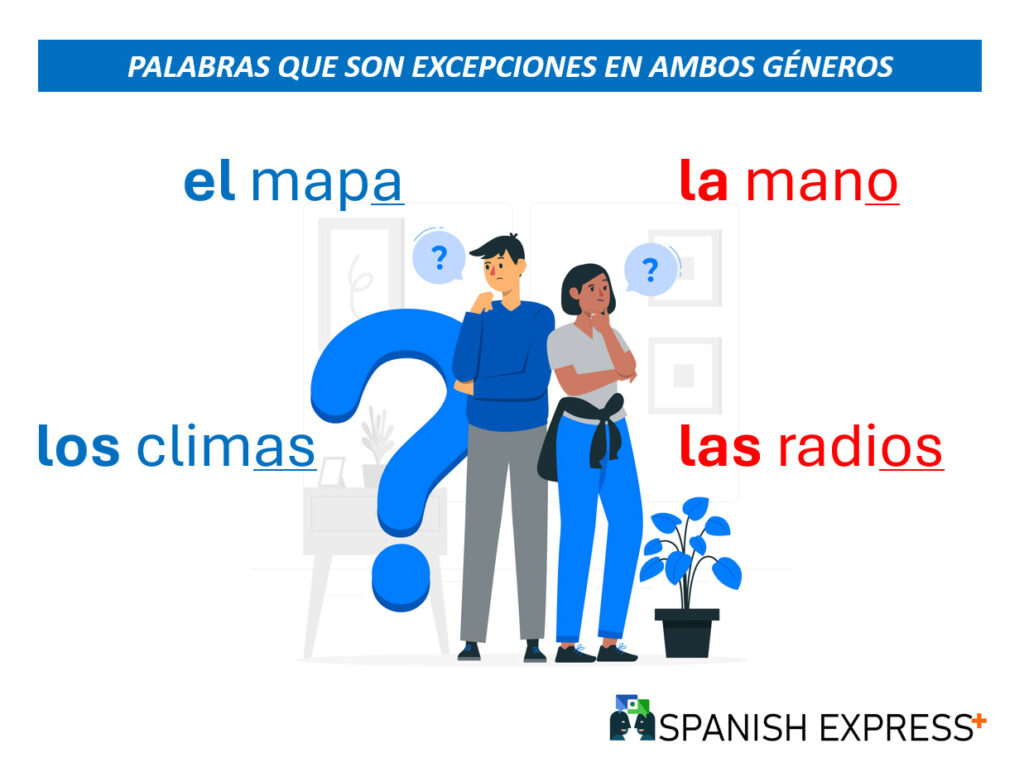
EXCEPCIONES DE SUSTANTIVOS QUE TERMINAN EN “O” O CONSONANTE Y LLEVAN ARTÍCULO FEMENINO:
- La mano – the hand
- La radio – the radio
- La foto – the photo (short for “fotografía”)
- La moto – the motorcycle (short for “motocicleta”)
- La nariz – the nose
- La disco – the nightclub (short for “discoteca”)
- La polio – the polio (short for “poliomielitis”)
- La tribu – the tribe
- La flor – the flower
- La piel – the skin
- La cárcel – the prison
- La sal – the salt
- La ley – the law
- La labor – the work/labor
- La señal – the signal
- La luz – the light
- La coliflor – the cauliflower
- La razón – the reason
- La imagen – the image
- La catedral – the cathedral
EXCEPCIONES DE SUSTANTIVOS QUE TERMINAN EN “A” O CONSONANTE Y LLEVAN ARTÍCULO MASCULINO:
- El día – the day
- El mapa – the map
- El planeta – the planet
- El sofá – the sofa
- El problema – the problem
- El tema – the topic/subject
- El clima – the climate
- El idioma – the language
- El papá – the dad
- El drama – the drama
- El dilema – the dilemma
- El sistema – the system
- El esquema – the scheme
- El poema – the poem
- El programa – the program
- El síntoma – the symptom
- El cometa – the comet
- El lápiz – the pencil
- El monarca – the monarch
- El atleta – the athlete
Descripciones en con artículo masculino “el”:
El cometa es verde Los cometas son verdes
El programa es aburrido Los programas son aburridos
El día es maravilloso Los días son maravillosos
El planeta es azul Los planetas son azules
El día es muy bueno Los días son muy buenos
Descripciones en con artículo femenino “la”:
La mano es grande Las manos son grandes
La foto es muy bonita Las fotos son muy bonitas
La señal no es clara Las señales no son claras
La Catedral es enorme Las catedrales son enormes
La tribu es interesante Las tribus son interesantes
- Published in Uncategorized